Length Converter
Metric, Imperial And Back
This length converter turns metres, centimetres, inches, feet, yards and miles into one another as you type. So one measurement shows up in metric and imperial at once. It also uses the exact factor for each unit and prints it, so you can check the maths. Because it all runs in this tab, nothing you type is uploaded or stored.
- FreePrice
- Metric + imperialUnits
- Both waysDirection
- NoneUploads
Length Converter
Metres, feet, inches, miles and more, all from one value
- Micrometre
- Millimetre
- Centimetre
- Metre
- Kilometre
- Inch
- Foot
- Yard
- Mile
- Nautical mile
- Astronomical unit
- Light-year
Type a length to see it in every unit.
What A Length Converter Does
A length is a count of one fixed unit, so moving between units is pure multiplication. Therefore, unlike temperature, zero in one unit is zero in every other, and there is no offset to add. The whole job is picking the right factor and multiplying by it.
That is what this length converter does for you. Because it holds the exact factor for every unit, it turns metres into feet or centimetres into inches without the drift of a decimal remembered from school. For more detail, see the Wikipedia article on the metre.
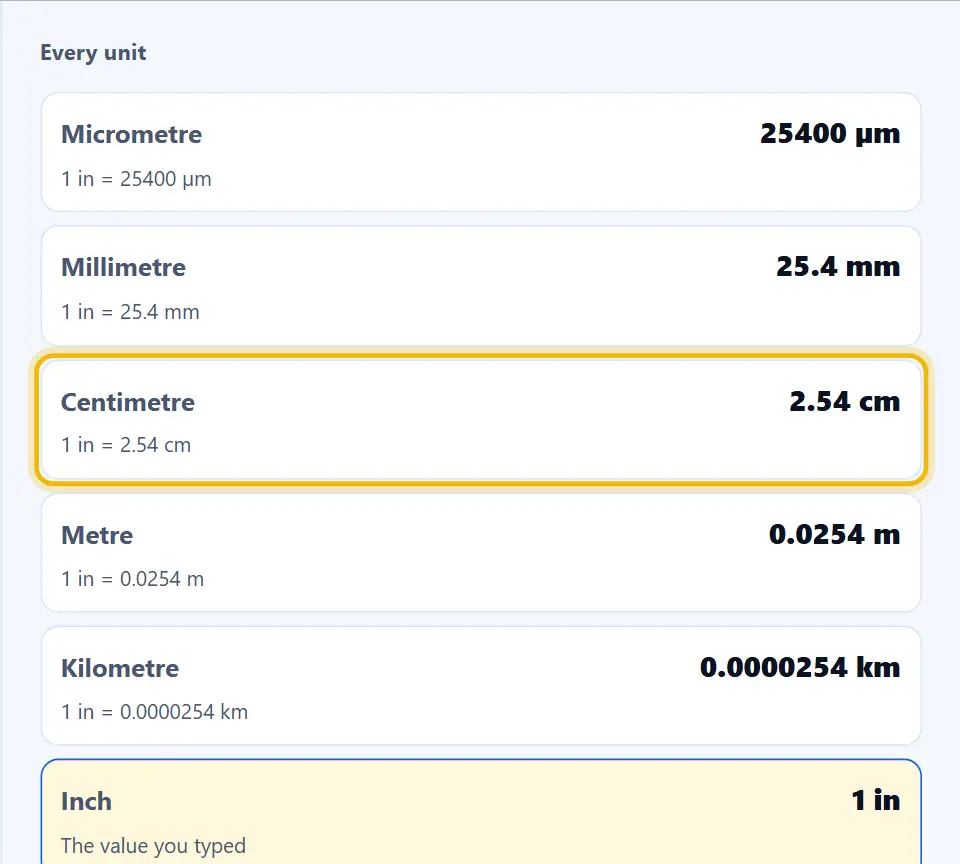
Next to each answer, the page shows the factor it used. For example, an inch is exactly 2.54 centimetres, and the page prints that line. So the number is never a guess.
It converts in every direction at once. So you type one value, and every metric and imperial length updates together. That saves you looking up one pair at a time.
Also, nothing leaves this tab. So a measurement from a drawing, a recipe or a parcel label is safe to type, because the maths happens in your browser and the page stores nothing.
How A Length Converter Works
First, the converter reads your number and its unit. Then it turns that into the base unit, because every length has a fixed factor to and from the metre.

Next, it sends that value out to every other length. One step to the base and one step back out covers each pair. That is why all the rows agree at once.
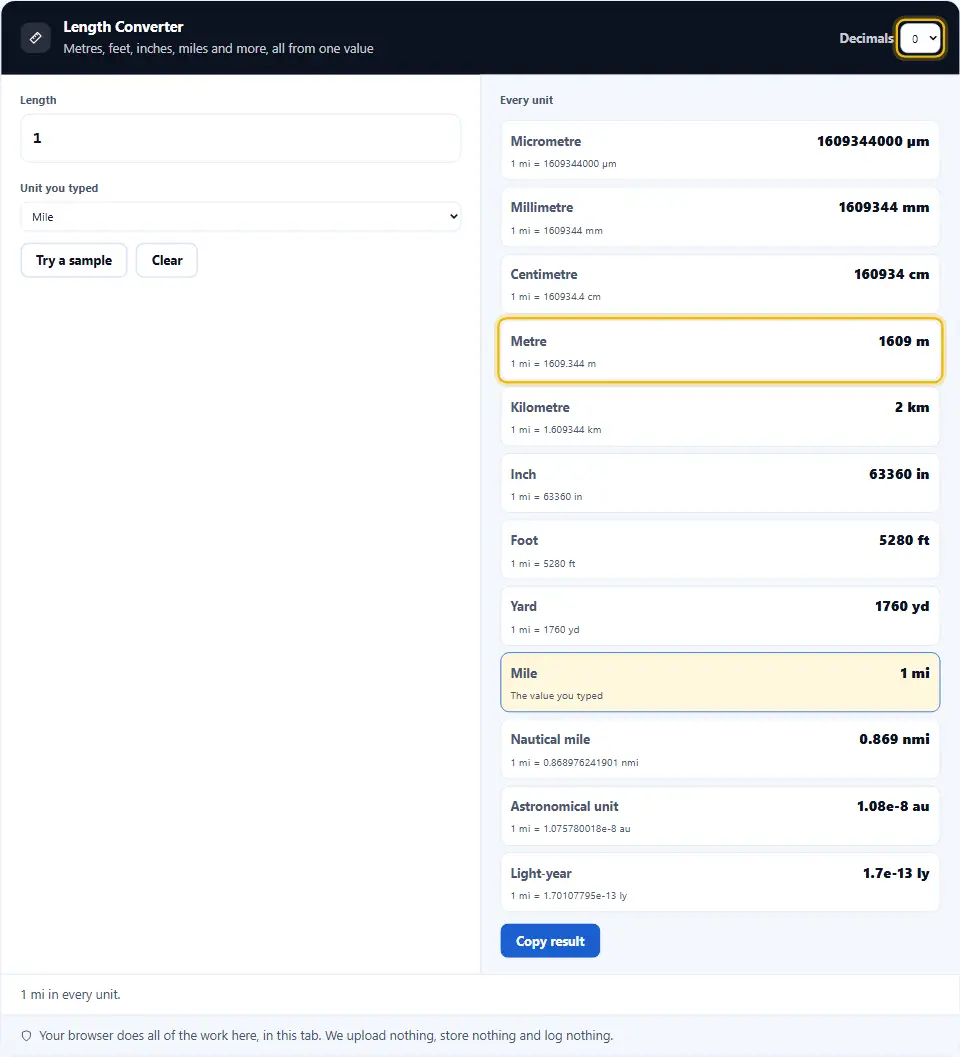
Each factor is a constant, not an estimate. An inch is defined as exactly 2.54 centimetres, and a mile as exactly 1609.344 metres. So the conversion is exact, not rounded.
The page also keeps far more digits than it shows. Therefore, the rounding on screen never feeds the next step. A round trip from metres to feet and back lands on the number you started with.
Why Length Is Simpler Than Temperature
A temperature scale needs a stretch and a shift, because the scales do not share a zero. However, length has no such offset, so a length converter only multiplies.
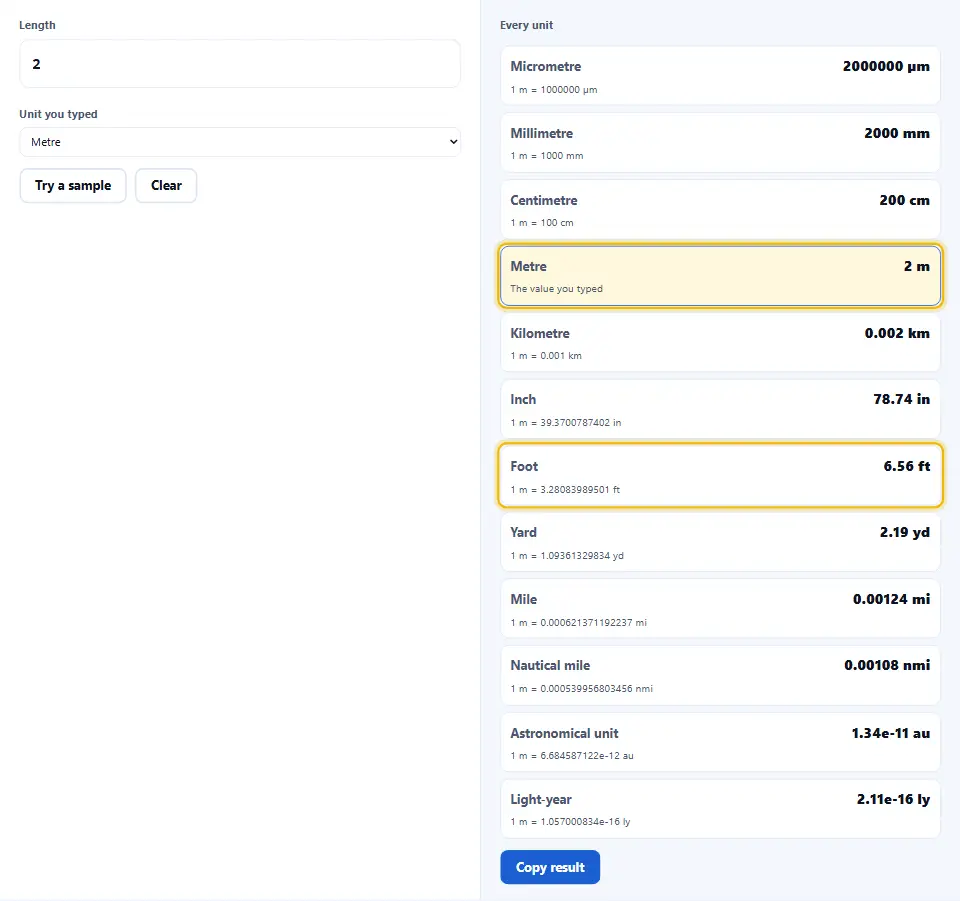
That is why zero metres is zero feet and zero inches. So one factor describes each unit fully, and no plus or minus step hides in the maths.
It also means a ratio makes sense here. Because the units share a zero, two metres really is twice one metre. That is not true of two degrees on a thermometer.
In short, length is the easy case. Still, the factors have to be exact, and that is the one place a careless conversion goes wrong.
Metric And Imperial, Side By Side
The metric units step by tens. So a centimetre is ten millimetres, a metre is a hundred centimetres, and a kilometre is a thousand metres. Moving the decimal point is the whole trick.
The imperial and US units step by mixed amounts. For example, twelve inches make a foot, three feet make a yard, and 1760 yards make a mile. So each jump has its own number.
The two systems meet at one exact point. Because an inch is defined as 2.54 centimetres, every other imperial length follows from that single fact.
A nautical mile is different again. It is exactly 1852 metres, first set from the size of the Earth. So it does not line up with the land mile.
What This Length Converter Will Not Do
It will not measure anything. The page has no ruler, so it only converts the number you type. It is a calculator, not a measuring tool.
It will not mix up the two kinds of foot. The US survey foot and the international foot differ by a hair. So the page uses the international foot and says so, instead of mixing them.
It will not pretend an agreed constant is a measurement. So a light-year or an astronomical unit uses the standard agreed value, and the page treats it as that fixed constant.
It will not round away your precision. The full value is kept behind the scenes, and only the display is rounded to the decimals you choose. So nothing drifts between steps.
Watch the Length Converter in Action
A short video walks through every step. Then pick your language below, and turn on captions if you like.
How To Use The Length Converter
Four steps, and none of them need an account.
- 1
Type the length
Type any number, including a decimal or a very small one. Because the converter reads as you type, the other lengths fill in before you finish.
- 2
Pick the unit you typed
Then pick the unit of that number: metres, inches, miles or any other. Since every row updates together, you only set the one you started from.
- 3
Read every length at once
Next, read the matching value in each other length, with the factor shown below it. So the answer and the maths behind it sit side by side.
- 4
Copy or round as you like
Finally, choose how many decimals to show and copy the result. After that, the figure is ready for your drawing, your order or your note.
Why Use This Length Converter
Five reasons, and each one saves a lookup.
It converts every length at once
Because one value feeds every length, you never convert one pair at a time. So metres to feet and feet to metres happen on the same screen.
It shows the exact factor
Each answer prints the factor it used. Therefore, you can check the maths yourself instead of trusting a black box.
It keeps full precision
The page rounds only what it shows, not what it keeps. Hence a round trip returns the number you began with, with no drift.
It uses exact definitions
An inch is exactly 2.54 centimetres, and a mile is exactly 1609.344 metres. As a result, the conversion never uses a rounded factor from memory.
Nothing uploads
The whole job runs in this browser tab. So a measurement from a plan or a parcel is safe to type and leaves no trace.
Habits That Keep Length Maths Right
Six habits that keep a conversion honest.
- Write the unit next to the number On its own, 5 means little, but 5 metres is clear. Because a bare number hides the unit, a label stops the most common mix-up.
- Keep metric and imperial apart A number is in metres or in feet, never both. Therefore, decide the unit first, since the two look the same on paper.
- Round at the end, not partway Each early rounding nudges the answer a little. Hence keep the full value until the last step, which is exactly what this page does for you.
- Mind the mile you mean A land mile and a nautical mile are different lengths. So pick the right one, because sea and air distances use the nautical mile.
- Watch very small and very large units A micrometre and a kilometre sit far apart. Still, the converter keeps the digits, so a tiny gap and a long road both stay exact.
- Sanity-check against something you know A metre is about 3.28 feet, and an inch is about 2.5 centimetres. So compare a surprising answer with those, and a slip shows up at once.
Six Ways Length Conversions Go Wrong
None of these breaks the maths, which is exactly why they slip through.
Using a rounded factor
Treating an inch as 2.5 centimetres instead of 2.54 looks close. However, the gap grows with every inch, so a long run drifts well off.
Mixing metric and imperial
Reading a metre as a yard is an easy slip, because they are close. However, a metre is a little longer, so the error adds up over a distance.
Confusing the two feet
The US survey foot and the international foot differ by a sliver. So a surveying figure can drift if the wrong foot is used.
Forgetting the mile has 1760 yards
A mile is not a round thousand of anything. Therefore, guessing the step between yards and miles lands wide.
Rounding too soon
An answer rounded at every step collects error. Hence a figure that looks exact can be off once several conversions stack up.
Treating a nautical mile as a land mile
A nautical mile is longer than a land mile. So a sea or air distance read as land miles comes out wrong.
Length Converter Questions
Is this length converter free?
Yes. There is no account, no limit and no paid tier. So you can convert as many measurements as you like.
Does it upload what I type?
No. The whole job runs in this browser tab, and nothing is sent anywhere. So a measurement from a plan or a label stays with you.
Which units does it cover?
It covers metric units from micrometres to kilometres and imperial units from inches to miles. It also has the nautical mile, the astronomical unit and the light-year. So common lengths all update from one value.
How do I convert centimetres to inches?
Divide the centimetres by 2.54, because an inch is exactly 2.54 centimetres. So 10 centimetres is about 3.94 inches, and the page prints that factor.
How do I convert inches to centimetres?
Multiply the inches by 2.54. So 6 inches is 15.24 centimetres, the reverse of the other direction.
How do I convert metres to feet?
Multiply the metres by about 3.2808. So 10 metres is about 32.81 feet, and the exact factor comes from the inch definition.
How many metres are in a mile?
Exactly 1609.344 metres. So a mile is a fixed length, not a rounded one, and the converter uses the exact figure.
What is a nautical mile?
It is exactly 1852 metres, first set from the size of the Earth. So it is longer than a land mile, and it is used at sea and in the air.
Does it handle very small or very large lengths?
Yes. A micrometre and a kilometre both work, and the page keeps the digits instead of rounding a small value away.
How many decimals does it show?
You choose, from a whole number up to eight decimals. Because the page keeps full precision inside, the answer does not drift when you change it.
Is a yard the same as a metre?
No, but they are close. A metre is about 1.094 yards, so reading one as the other is a common and costly slip.
Can it convert a whole list at once?
No. It shows one measurement in every length at once. So convert values one at a time, which keeps each answer and its factor clear.
Does it round or truncate?
It rounds to the decimals you pick, and it rounds only the display. Therefore, the value behind it stays exact for the next conversion.
Why do my hand maths differ slightly?
Usually because a factor was rounded too early. So keep the full value until the end, which is what the converter does for you.
What is the difference between the US and international foot?
They differ by about two parts in a million. So for everyday work they match, but the page uses the international foot to stay consistent.
How do I convert kilometres to miles?
Divide the kilometres by 1.609344. So 5 kilometres is about 3.11 miles, using the exact number of metres in a mile.
Does it need the internet after loading?
No. Because the factors are built into the page, it keeps working offline once the tab is open.
Does it work on a phone?
Yes. The two panels stack on a small screen, and the fields stay large enough to tap. So a quick conversion works on a phone as well as a desktop.
Is it a ruler or a measuring tool?
No. It has no sensor, so it converts the number you type instead of measuring anything. For a real measurement, you still need a ruler or a tape.
Can I convert feet to metres directly?
Yes. The page goes through the base unit for you. So you type feet and read metres without doing two steps by hand.
Does it cover points and picas?
It focuses on physical lengths. So for typographic points and picas, use the pixel and rem converter, which is built for screen units.
What about my privacy?
Everything happens in the browser, so nothing you type is stored or sent. Of course, you can watch the network tab to confirm it.
Tools That Go With This One
Four pages the same work usually leads to.
The other everyday converter, where the scales carry an offset instead of a plain factor. So see how Celsius, Fahrenheit and Kelvin line up.
Open tool →Need weight, speed or area too? The hub carries every category on one page, so every other measure is one click away.
Open tool →Move a value between decimal, binary, octal and hex. Then a figure from code reads the same in every base.
Open tool →For screen lengths instead of physical ones, swap CSS pixels and rems. Because it keeps the ratio exact, your spacing stays true.
Open tool →
Convert It, Then Carry On
Type a measurement, pick its unit, and read it in every other length with the factor below. Nothing is stored or uploaded. Also, every factor is the exact defined value, not a rounded guess.