Random Word Generator
Filtered The Way You Need It
This random word generator draws from four hundred everyday English words, filtered by part of speech, by length and by first letter. Each pick relies on the cryptographic randomness built into your browser.
- FreePrice
- 400+Words
- 200 imagesPer draw
- NoneUploads
Random Word Generator
Draw words by type, length and first letter
- Drawn
- 0
- Pool
- 0
- Average length
- 0
Words are drawn with your browser's cryptographic random source, so two visitors pressing the button together get different lists.
Ready. Set the filters and draw.
Jobs a Random Word Generator Does Well
People arrive here for four reasons: a writing prompt, a name for a project, a round of charades or Pictionary, or words to test a form with. Each of the four needs the very same thing. They want words a reader already knows.
That is why this list is short and ordinary rather than enormous and obscure. A generator that hands you sesquipedalian and thurible has technically done its job, yet you cannot use either one.
Each word carries its part of speech, so the filters are real filters. Ask for adjectives and you get adjectives, not everything ending in a familiar suffix.
The picking process makes up the rest. A random word generator is only as good as the way it picks, and picking fairly from a list takes slightly more care than it looks.
How the Tool Picks Each Word
Every pick comes from crypto.getRandomValues, the same source a browser uses for keys, rather than from Math.random. Then the draw discards any value that would fall in an uneven remainder and tries again.

The second step deserves more attention than it seems. Taking a random number modulo the list length makes the first few words slightly more likely than the last few, and over many draws the tilt becomes visible.
Two people who press the button at the same second still see different lists. No word sits quietly at the front of the queue.
Using Random Words As A Prompt
Draw three nouns and one verb, then write a paragraph that uses all four. The constraint does the work: because you did not choose the words, you cannot fall back on the sentence you always write.
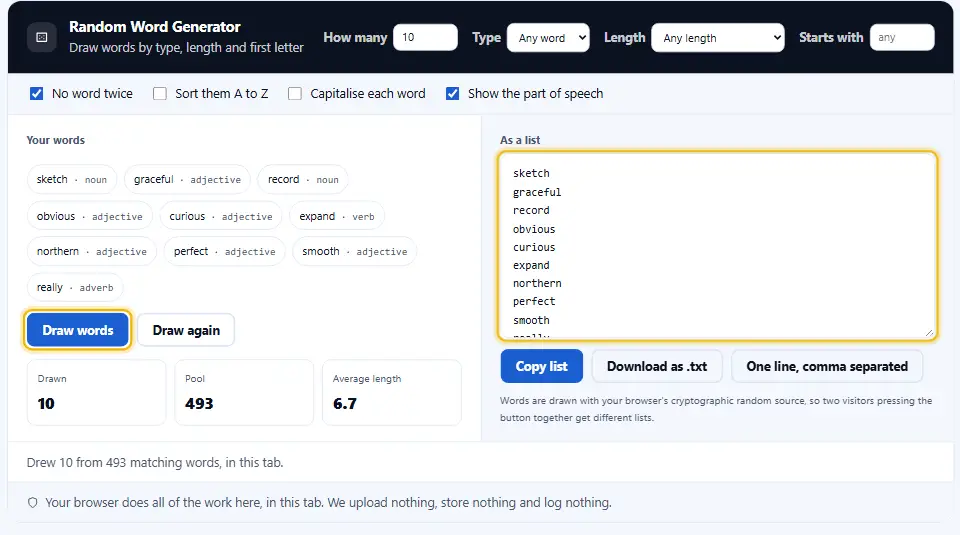
For a longer session, draw ten and keep the four that surprise you. Writers have used this trick with dictionaries and dice for a century, and a browser simply makes it faster.
Playing Games With A Word List
Charades, Pictionary and drawing games all need words a whole room knows. Short nouns work best, so set the length to short and the type to nouns.
For a speaking round, draw three words and give the speaker a minute. The awkward pairings are the point, and a curated list of prompts never produces them.
Teachers use the same trick for spelling practice and vocabulary warm-ups. Because the pool is ordinary English, the words stay fair for younger players.
The Source Behind Each Random Pick
Your browser provides crypto.getRandomValues, which fills numbers from the operating system's own random source. That is the same source used for keys, and it is far better than Math.random.
A fair draw also has to throw some numbers away. Otherwise the remainder rule tilts the odds toward the start of the list, which is the same flaw that dice-based schemes such as Diceware avoid by rolling dice.
Not For Passwords
A passphrase needs a much larger list and several words. Use the password generator on this site instead, which draws from a proper word list and shows you the strength in bits.
Working With the Random Word Generator
Four steps, though the first alone gives you words. Meanwhile the pool counter shows how many words match your filters.
- 1
Say how many you want
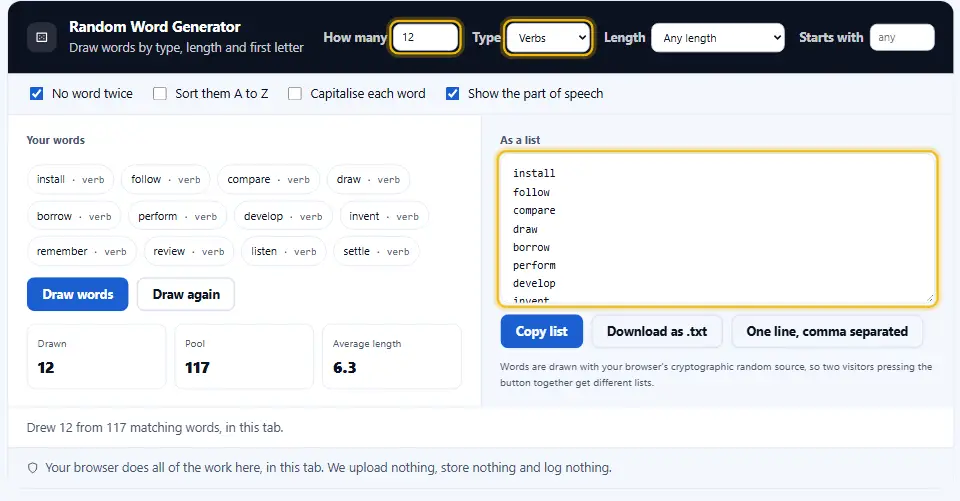
Any count between 1 and 200. Ten is a good starting point for a prompt, while a game round usually wants three or four.
- 2
Narrow the type
Pick nouns, verbs, adjectives or adverbs from the menu. The pool number updates immediately, so you can see when a filter has left too little to draw from.
- 3
Add length or a first letter
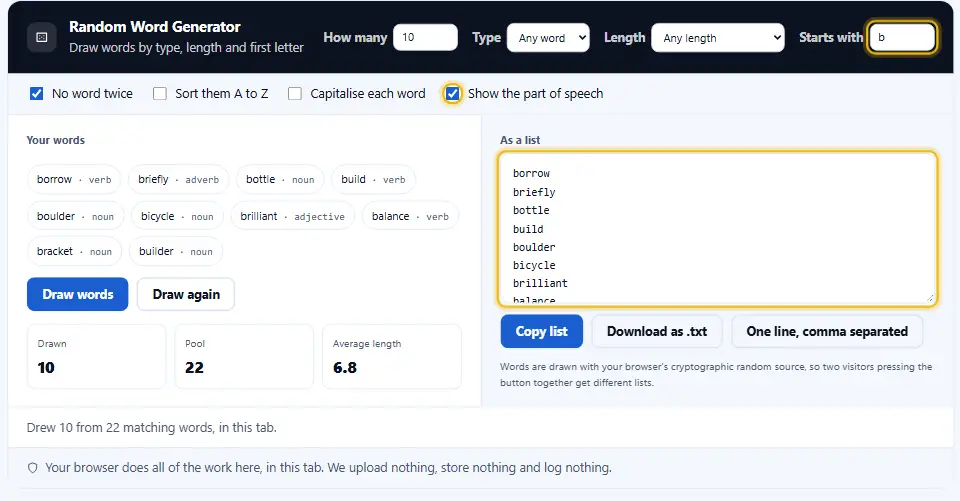
Short words suit games, long ones suit prompts. For instance, typing s in the letter box limits the draw to words starting with that letter.
- 4
Draw, then draw again
Press the button as often as you like. Copy the list, save it as a text file, or switch it to one comma separated line for a spreadsheet.
Where This Word Generator Goes Further
Most generators hand you a list and nothing else. The differences here are in the filters, the randomness and the privacy.
Real parts of speech
We tagged every word by hand as a noun, verb, adjective or adverb. So the filter returns what it promises rather than a guess.
Proper randomness
Draws come from your browser's cryptographic source with the modulo bias removed, so no word sits quietly at the front of the queue.
Each word appears once unless you allow repeats
Unique draws are the default. Untick the switch when you want a list that can repeat, such as dice-style practice rounds.
A pool counter you can trust
Before you draw, the page says how many words match. Therefore an impossible filter is obvious instead of silently returning three words.
Two output shapes
Chips to read and a plain list to copy. A single press joins the list into one comma-separated line, ready for a spreadsheet or a script.
Nothing leaves your tab
The word list ships with the page, so no request goes out when you press the button and nothing records what you drew.
Getting Better Results From Random Words
A random list is raw material. These habits turn it into something you can actually use.
- Pull extra words, then trim the list. Ask for ten and keep three. Choosing from a wider set beats accepting the first thing that appears, especially for names.
- Mix the parts of speech deliberately. Two nouns and a verb make a sentence shape. Three adjectives make a mood instead, which suits a writing prompt better.
- Say the shortlist out loud for names. A project name lives in conversation before it lives on a page. If it sounds awkward out loud, somebody will replace it within a month.
- Search a name before you adopt it. Search for it, then check the domain and the handles you need. A word is only available until somebody else has taken it.
- Use the first letter box for alliteration. Two words beginning with the same letter stick in memory. So a quick filter does in one draw what browsing a dictionary does in ten minutes.
- Keep the rejects. Copy each draw into a note. The word you dismissed today often fits the project you start next month.
- Set a timer for prompts. Ten minutes on three random words beats an hour of staring. The constraint works because it removes the choice, so put the clock on as well.
- Pick word lengths that suit the game you play. Short words suit drawing and charades. Long words suit spelling practice, where the difficulty is the whole exercise.
Three Ways Random Words Go Wrong
Each of these turns a useful draw into wasted time, and all three are easy to sidestep.
Treating the words as a password
Four hundred words is far too small a pool for a passphrase. Use a dedicated generator that shows the strength in bits instead.
Adding filters until the list is empty
Long adverbs starting with z do not exist here. Watch the pool counter, because an empty pool means the filters, not the tool, are the problem.
Treating the first draw as the answer
The point of randomness is volume. Draw several times and compare, rather than accepting whatever the first press happened to produce.
Naming a product from one word alone
Somebody already owns nearly every common word as a domain and a handle. Pair two words, or add a short suffix, before you check what remains free.
Expecting rare or technical words
This list holds everyday English on purpose. For obscure terms you want a dictionary, since a game played with words nobody knows stops being a game.
Sorting the list and calling it random
Sorting is only a display choice. It helps you read a long draw, yet the order tells you nothing about how the tool picked the words.
Random Word Questions People Ask
How many words does this random word generator hold?
Just over four hundred, tagged as nouns, verbs, adjectives and adverbs. They are common English words on purpose, since obscure ones are useless for prompts, names and games.
Can the Denwix generator repeat a list I liked?
Only by chance, and with ten words that chance is tiny. The page keeps no seed and saves no history, so every press starts fresh.
Are these words really random?
They come from your browser's cryptographic random source, with the modulo bias removed by discarding uneven values. That is as close to uniform as a draw gets.
Can I draw only words starting with one letter?
Yes. Type that letter in the box and the pool shrinks to words beginning with it. Alliteration sticks in memory, which makes this useful for names and slogans.
How many words can I draw at once?
Two hundred in one press. With no repeats ticked you get as many as the filters allow, and the status line says so plainly when that is fewer.
Can I use these for a passphrase?
Please do not. The pool is too small to be safe. The password generator on this site draws from a larger list and reports the strength in bits.
Why did I get fewer words than I asked for?
Because you left no repeats ticked, and the filters matched fewer words than you asked for. Widen the filters, or untick that switch to allow repeats.
Does the word list work for Pictionary or charades nights?
Yes, and party games are among its top uses. Set the type to nouns and the length to short, then draw one word per round so nobody sees the next one.
How do I get a writing prompt rather than a single word?
Draw four words with the type left on any, then write a paragraph that uses all four. The mix of a noun, a verb and an adjective gives a sentence something to be about.
Can I keep the same words after refreshing?
Copy them or download the list first. The page stores nothing between visits, so a refresh always starts a fresh draw.
Does the page send anything to a server?
No. The list ships inside the page, and every draw happens in your tab. A random word generator for games should not need your data, and this one never asks.
Tools People Use Beside This One
A random draw is usually step one. These three cover what tends to happen next.
Placeholder paragraphs, sentences and list items on demand.
Open tool →Strong passwords and passphrases, with the strength shown in bits.
Open tool →Turn the name you picked into a clean URL slug.
Open tool →
Ready To Draw?
Set the filters, press the button, and keep the words that surprise you. The random word generator is free, needs no account, and runs entirely in your browser.