Speed Converter
mph to km/h, Meters Per Second And Knots
This speed converter turns mph to km/h, meters per second, knots and feet per second as you type. So one reading shows up in every unit at once. It also uses the exact factor for each unit, keeps full precision behind the rounding, and prints the factor so you can check it. Because it all runs in this tab, nothing you type is uploaded or stored.
- FreePrice
- Metric, imperial, knotsUnits
- Both waysDirection
- NoneUploads
Speed Converter
km/h, mph, meters per second, knots and feet per second, all from one value
- Kilometer per hour
- Mile per hour
- Meter per second
- Foot per second
- Knot
Type a value to see it in every unit.
What An mph to km/h Converter Does
A speed is a distance over a time, so its unit joins a length and a time, like meters per second or miles per hour. Therefore, converting a speed means converting both parts together. So the whole job is folding both into one factor and multiplying by it.
That is what this speed converter does for you. Because it holds the exact factor for every unit, it turns mph to km/h, or meters per second into knots, with no drift from a half-remembered decimal. For more detail, see the Wikipedia article on the meter per second.
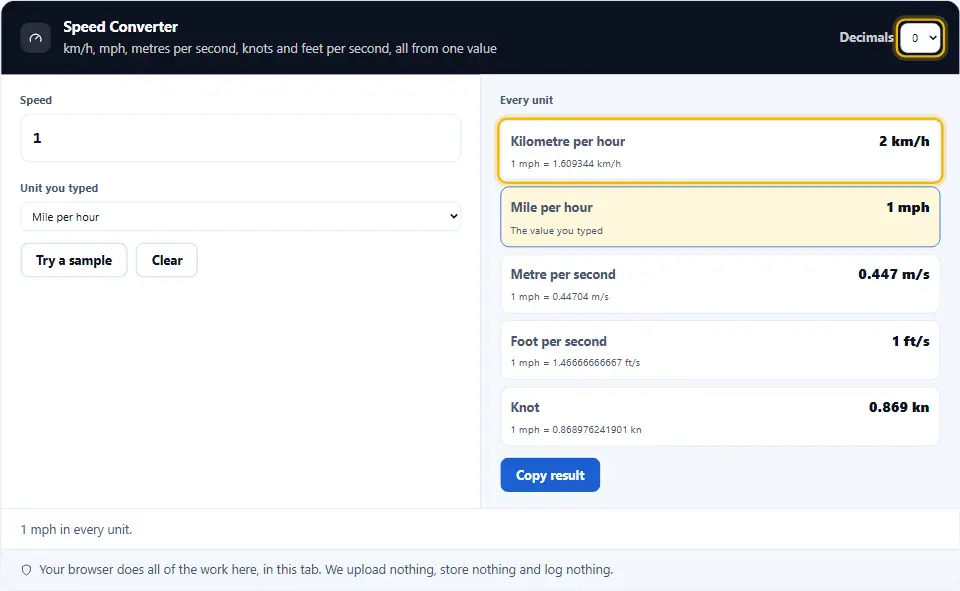
Next to each answer, it shows the factor it used. For example, a mile per hour is exactly 0.44704 meters per second. The page prints that line, so the number is never a guess.
It converts in every direction at once. So you type one value, and every unit updates together. That saves looking up one pair at a time.
Nothing leaves this tab, either. Hence a reading from a car, a run or a weather report is safe to type, because the maths happens in your browser and the page stores nothing.
How mph to km/h Conversion Works
First, the converter reads your number and its unit. Then it turns that value into meters per second, the base unit, because every speed has a fixed factor to and from it.

Next, it sends that value out to every other unit. So one step to the base and one step back covers each pair. That is why all the boxes agree at once.
The metric link is a tidy 3.6. An hour is 3,600 seconds and a kilometer is 1,000 meters. As a result, one meter per second is exactly 3.6 kilometers per hour.
The page also keeps far more digits than it shows. Therefore, the rounding on screen never feeds the next step. A round trip from mph to km/h and back lands on the number you started with.
Why A Speed Joins Two Units
A length converter moves one unit, but a speed carries two: a distance and a time. Both have to convert at once, or the rate comes out wrong.
For example, miles per hour to meters per second changes the mile to meters and the hour to seconds together. So the single factor 0.44704 already folds both steps in.
The time part is why 3.6 keeps showing up. Because an hour has 3,600 seconds, any per-hour unit carries that 3,600 against the per-second ones.
In short, the converter does both halves for you. Still, it helps to remember that a speed is a ratio, not a plain length.
mph to km/h And Everyday Speeds, Side By Side
Walking is about 1.4 meters per second. That is roughly 5 km/h, or about 3.1 mph, a handy anchor.
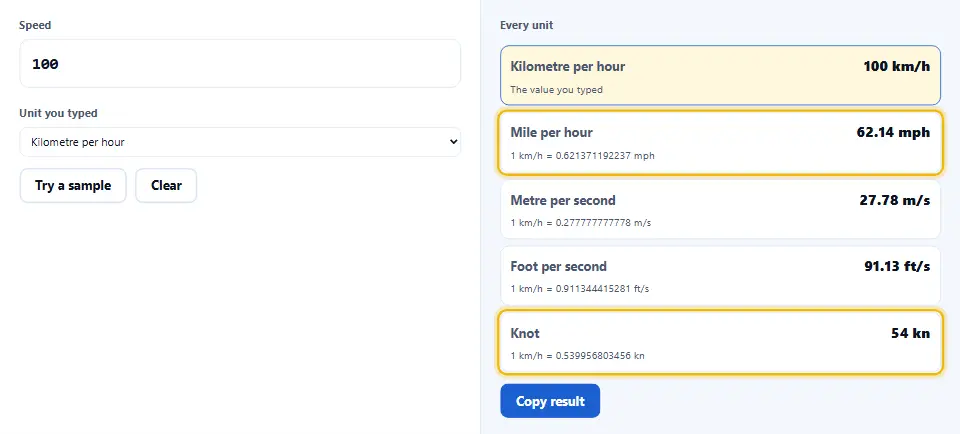
A highway limit of 100 km/h is about 62 mph. For example, that is the gap drivers meet when they cross from Canada into the United States, and the reason mph to km/h matters on the road.
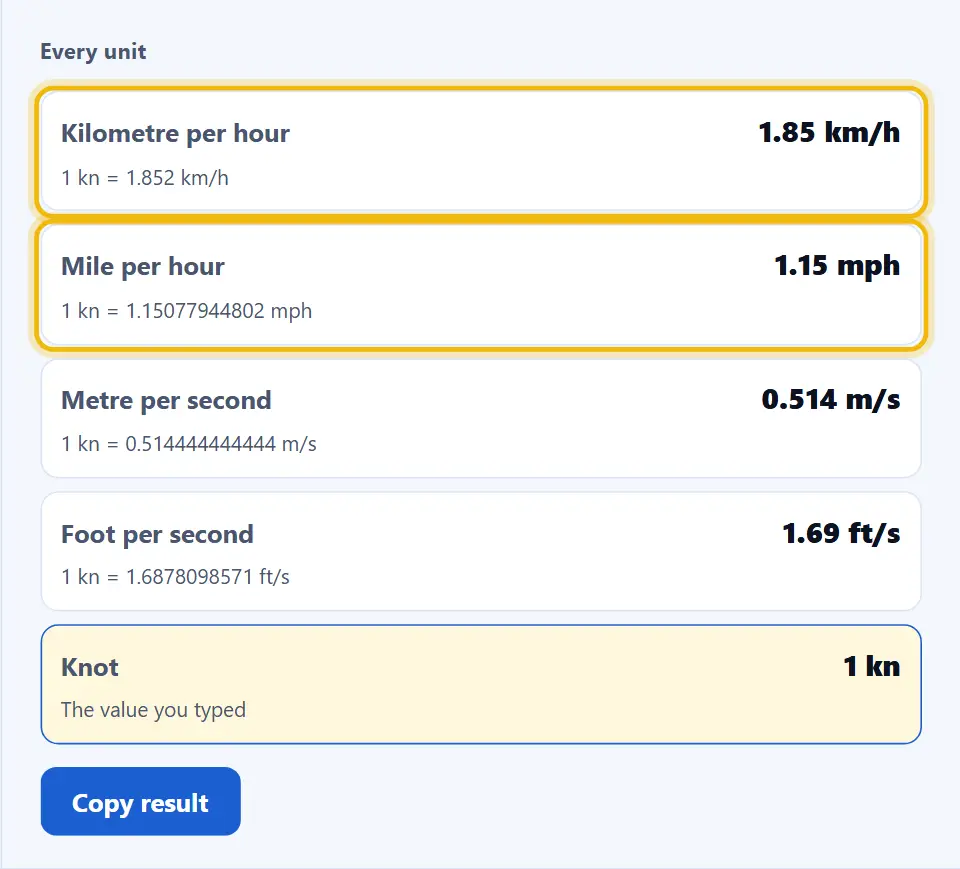
A knot is one nautical mile per hour. It is exactly 1.852 km/h, and it is used at sea and in the air instead of on the road.
The speed of sound is about 343 meters per second in air at 20 °C. Hence it is about 1,235 km/h, though it shifts with temperature.
What This Speed Converter Will Not Do
It will not measure your speed. The page has no sensor, so it converts the number you type and nothing more. It is not a speedometer or a GPS.
It will not treat a speed as a plain length. Because a speed carries a time as well, the page folds both into the factor instead of converting only the distance.
It will not confuse a knot with a land speed. A knot is a nautical mile per hour, so the page names it instead of reading it as an ordinary mile per hour.
It will not round away your precision. The full value stays behind the scenes, and only the display is rounded to the decimals you choose. So nothing drifts between steps.
Watch the Speed Converter in Action
A short video walks through every step. Then pick your language below, and turn on captions if you like.
How To Convert mph to km/h Here
Four steps, and none of them need an account.
- 1
Type the speed
Type any number, decimals included. Because the converter reads as you type, the other units fill in before you finish.
- 2
Pick the unit you typed
Then pick the unit you typed: meters per second, km/h, mph, knots or feet per second. Since every box updates together, you only set the one you started from.
- 3
Read every unit at once
Next, read the matching value in each other unit, with its factor shown. So the answer and the maths behind it sit side by side.
- 4
Copy or round as you like
Finally, choose how many decimals to show and copy the result. After that, the figure is ready for your car, your run or your report.
Why Use This Speed Converter
Five reasons, and each one saves a lookup.
It folds both units in
Because a speed is a distance over a time, the page converts both parts at once. So mph to km/h is never half done.
It converts every unit at once
One value feeds every unit, so you never convert one pair at a time. Therefore, mph to km/h and km/h back to mph sit on the same screen.
It shows the exact factor
Each answer shows the factor it used. Hence you can check the maths yourself instead of trusting a black box.
It keeps full precision
The page rounds only what it shows, not what it stores. As a result, a round trip returns the number you began with, with no drift.
Nothing uploads
The whole job runs in this browser tab. So a reading from a car or a weather report is safe to type, and it leaves no trace.
Habits That Keep Speed Maths Right
Six habits that keep a conversion honest.
- Remember a speed is a rate A speed is a distance over a time, not a plain length. So convert both parts, which the page folds into one factor for you.
- Use 3.6 between m/s and km/h One meter per second is exactly 3.6 km/h. So multiply or divide by 3.6 to move between them.
- Keep knots for sea and air A knot is a nautical mile per hour. Therefore, use it for a boat or a plane, not for a car on the road.
- Round at the end, not partway Each early round nudges the answer a little. Hence keep the full value until the last step, which is what this page does for you.
- Write the unit next to the number The number 60 on its own means little, because 60 km/h and 60 mph are far apart. Since a bare number hides the unit, a label stops a mix-up.
- Sanity-check against something you know Walking is about 5 km/h, and a highway is about 100. So compare a surprising answer with those, and a slip shows up at once.
Six Ways Speed Conversions Go Wrong
None of these breaks the maths, which is exactly why they slip through.
Reading km/h as mph
A limit of 100 km/h is about 62 mph, not 100. So reading one as the other overstates a speed badly.
Forgetting the 3.6
One meter per second is 3.6 km/h, not 1. Therefore, skipping the time step undercounts the speed.
Treating a knot as a land mile per hour
A knot is a nautical mile per hour, about 15% faster than a mile per hour. However, the names look alike, so the gap slips by.
Converting only the distance
A speed carries a time too. So changing the mile to meters but leaving the hour as it is gives the wrong rate.
Rounding too soon
An answer rounded at each step collects error. Hence a figure that looks exact can be off once several conversions stack up.
Mixing per-hour and per-second
An hour is 3,600 seconds. So a per-second figure read as per-hour is thousands of times off.
mph to km/h And Speed Converter Questions
Is this speed converter free?
Yes. There is no account, no limit and no paid tier. So you can convert as many readings as you like.
Does it upload what I type?
No. The whole job runs in this browser tab, and nothing is sent anywhere. So a reading from a car or a report stays with you.
Which units does it cover?
It covers meters per second, km/h, mph, knots and feet per second. So the common speeds all update from one value.
How do I convert km/h to mph?
Multiply by about 0.621371. So 100 km/h is about 62.14 mph, and the page prints that factor.
How do I convert mph to km/h?
To convert mph to km/h, multiply by 1.609344. So 60 mph is about 96.56 km/h.
How do I convert meters per second to km/h?
Multiply by exactly 3.6. So 10 meters per second is 36 km/h.
What is a knot?
A knot is one nautical mile per hour, exactly 1.852 km/h. So it is used at sea and in the air instead of on the road.
How do I convert mph to meters per second?
Multiply by 0.44704, exactly. So 60 mph is about 26.82 meters per second.
Why is the factor 3.6 between m/s and km/h?
An hour is 3,600 seconds and a kilometer is 1,000 meters. So 3,600 divided by 1,000 gives 3.6.
How do I convert knots to mph?
Multiply knots by about 1.15078. So 20 knots is about 23.02 mph.
Is a knot the same as a mile per hour?
No. A knot is about 1.15 mph, because it is based on the longer nautical mile.
Can it convert a whole list at once?
No. It shows one reading in every unit at once. So convert values one at a time, which keeps each answer and its factor clear.
Does it round or truncate?
It rounds to the decimals you pick, and it rounds only the display. Therefore, the stored value stays exact for the next conversion.
Why do my hand maths differ slightly?
Usually because the 3.6 step was skipped, or a value was rounded too early. So fold in the time and keep the full value until the end.
How fast is walking?
About 1.4 meters per second, which is roughly 5 km/h, or about 3.1 mph. So that is a handy anchor.
How fast is the speed of sound?
About 343 meters per second in air at 20 °C, which is near 1,235 km/h. However, it shifts with temperature.
Does it need the internet after loading?
No. Because the factors are built into the page, it keeps working offline once the tab is open.
Does it work on a phone?
Yes. The boxes stack and stay large enough to tap, so a quick conversion works on a phone as well as on a desktop.
Is it a speedometer?
No. It has no sensor, so it converts the number you type instead of measuring motion. For a real reading, you need a speedometer or a GPS.
Can I convert mph to km/h directly?
Yes. The page goes through meters per second for you, so you type mph and read km/h at once.
Does it do mach or the speed of light?
It focuses on everyday speeds. Mach shifts with air temperature, so a physics reference fits it better than a flat factor.
What about my privacy?
Everything happens in the browser, so nothing you type is stored or sent. Of course, you can watch the network tab to confirm it.
Tools That Go With This One
Four pages the same work usually leads to.
The distance half of a speed on its own, where a plain factor does the job. Convert meters, feet and miles there.
Open tool →Need weight, area or volume too? The hub puts every category in one place, with the same careful maths.
Open tool →For mass instead of motion, convert kilograms, pounds and tons the same careful way.
Open tool →Move a value between decimal, binary, octal and hex. Then a figure from code reads the same in every base.
Open tool →
Convert It, Then Carry On
Type a speed, pick its unit, and read it in every other unit with the factor below. Nothing is stored or uploaded, and a speed is handled as a rate, not a plain length.