What Is a DMARC Record?
Gmail and Yahoo now expect a DMARC record from anyone who sends a lot of mail. Without one, your mail can bounce or land in spam. A DMARC record is a TXT record in your DNS that tells receivers what to do when a message fails SPF and DKIM.
DMARC also checks something SPF alone does not: that the domain people see in the From line matches the domain that passed SPF or DKIM. As a result, it stops strangers from sending mail that looks like it comes from you.

How to Read a DMARC Record
A good first record looks like this:
v=DMARC1; p=none; rua=mailto:dmarc-reports@example.com- v=DMARC1 marks the record as DMARC.
- p=none only watches. Receivers deliver mail as before, but you get reports.
- p=quarantine sends failing mail to spam.
- p=reject refuses failing mail completely.
- rua= is the address that receives the daily summary reports.
So start with p=none. It changes nothing for delivery, yet it shows you every server that sends mail as your domain.
How to Add a DMARC Record
First, make sure SPF is in place, because DMARC builds on it. Then build the record with our free DMARC and SPF Generator. Choose the policy none and enter an address for the reports.
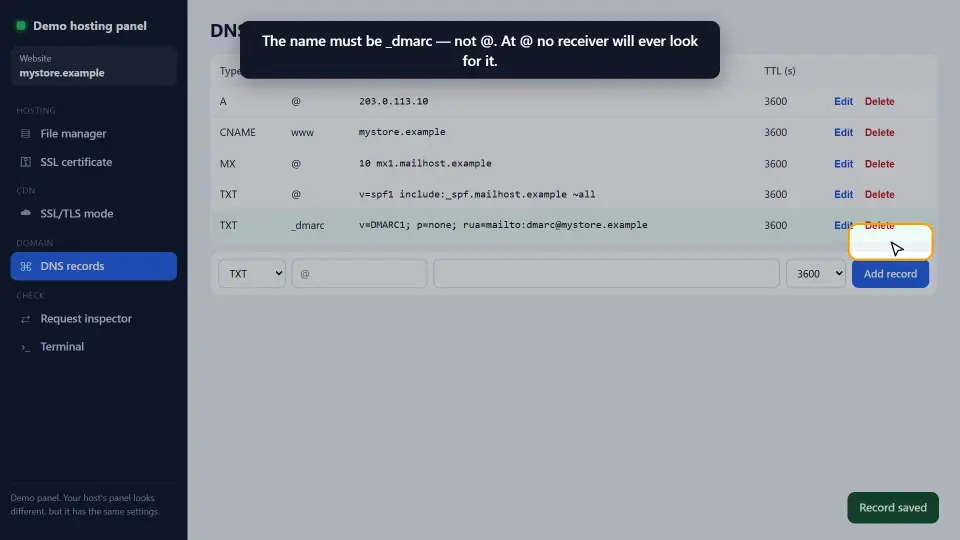
Next, add a TXT record in your DNS panel. The most common mistake is the name. It must be _dmarc, not @. At @, no receiver ever looks for it.
Finally, look it up to check it is live:
nslookup -type=txt _dmarc.example.comYou can also see it in our DNS Records Checker.
Reading the DMARC Reports
After a day or two, receivers such as Google and Microsoft start sending reports to the rua address. Each one is a small XML file that lists the servers that sent mail as your domain and whether they passed SPF and DKIM.
Look for real services that fail, such as a newsletter tool or a helpdesk. Fix those first, usually by adding them to SPF or setting up DKIM. Meanwhile, unknown servers that fail are often spoofers, and those are exactly what DMARC will block later.
From p=none to p=reject
Once your real services all pass, tighten the policy in steps. Therefore, do not jump straight to reject:
p=nonefor two to four weeks while you read the reports.p=quarantine; pct=25to send a quarter of failing mail to spam.p=quarantinefor all failing mail.p=rejectonce the reports stay clean.
In short, every step is a small change you can undo the same day if something breaks.
What DMARC Alignment Means
DMARC does not just ask whether SPF or DKIM passed. It also asks whether they passed for the same domain the reader sees in the From line. People call this match alignment.
SPF alignment
SPF checks the hidden return address, not the From line. So if a newsletter tool sends with its own return address, SPF can pass while alignment fails. Many tools let you set a custom return domain to fix this.
DKIM alignment
DKIM aligns when the signing domain, the d= value, matches your From domain. Therefore, set up DKIM with your own domain in every service that sends for you, not the service's default domain.
Relaxed and strict
By default, alignment is relaxed: mail.example.com counts as a match for example.com. Strict mode needs an exact match. Most sites should keep the default.
DMARC for Subdomains and Parked Domains
A record on your main domain also covers its subdomains, unless a subdomain has its own record. So one record at _dmarc.example.com is usually enough.
Domains that never send mail are an easy target for spoofers. For those, publish a strict policy straight away, together with an SPF record that allows nothing:
v=DMARC1; p=reject;Because no real mail comes from a parked domain, DMARC cannot block anything good. Meanwhile, receivers refuse fake mail that uses its name.
Common Mistakes
- Putting the record at @ instead of _dmarc.
- Starting with p=reject, so a forgotten service loses all its mail.
- Adding DMARC before SPF or DKIM works.
- Using a report address on another domain without the extra permission record that domain needs.
- Never reading the reports, so the policy stays at none for good.
In short: name _dmarc, start at none, read the reports, then tighten. For more detail, see Google's DMARC setup guide.
Questions and Answers
What is a DMARC record?
A TXT record at _dmarc.your-domain that tells receivers what to do with mail that fails SPF and DKIM, and where to send reports.
Where do I put the record?
At the name _dmarc in your DNS panel, as a TXT record. Not at @, where no receiver looks for it.
Which DMARC policy should I start with?
Start with p=none. It changes nothing for delivery but sends you reports, so you can fix real services before you tighten the policy.
Do I need SPF and DKIM for DMARC?
Yes. DMARC passes when SPF or DKIM passes and matches the From domain. Set up at least one of them, ideally both.
Does Gmail require DMARC?
Since 2024, Gmail and Yahoo require a record from bulk senders, those sending about 5,000 messages a day or more. For everyone else, Google strongly advises it.
What is the rua tag?
The mailto address that receives the daily summary reports. Use a mailbox you check, or a DMARC report service.
How long until my policy works?
Usually minutes, but DNS caching can delay it up to the TTL. Reports start to arrive after one or two days.
Can DMARC block my own mail?
Yes, with p=quarantine or p=reject, if a real service fails SPF and DKIM. That is why you start at p=none and read the reports first.
What is DMARC alignment?
The check that SPF or DKIM passed for the same domain shown in the From line. Without alignment, DMARC fails even if SPF passed.
Why does DMARC fail when SPF passes?
SPF passed for the service's return domain, not yours. Set up DKIM with your own domain, or a custom return domain, so one of them aligns.
What does sp= do?
It sets a separate policy for subdomains. Without it, subdomains follow the main p= policy.
What does pct= do?
It applies the policy to only part of the failing mail. For example, pct=25 with p=quarantine sends a quarter of failing mail to spam.
Should I use ruf for forensic reports?
It is optional. Many big receivers no longer send forensic reports, and they can contain personal data. The rua summary reports are enough for most sites.
Do subdomains need their own policy?
No. The record on the main domain covers them, unless you want a different policy for a subdomain.
What DMARC record should a parked domain have?
v=DMARC1; p=reject; together with an SPF record of v=spf1 -all. No real mail leaves it, so DMARC blocks nothing good.
Can I have more than one record at _dmarc?
No. If there are two TXT records at _dmarc, receivers ignore DMARC for the domain. Keep exactly one.
How do I read DMARC XML reports?
Open the XML file and look at each source IP, its count, and the SPF and DKIM results. A DMARC report service turns them into simple charts.
Does DMARC improve deliverability?
Yes. Big inbox providers trust mail from domains with a DMARC policy more, and it blocks fakes that hurt your name.
What is BIMI and does it need DMARC?
BIMI shows your logo next to your mail in some inboxes. It needs DMARC at quarantine or reject first.
Can I go back from p=reject to p=none?
Yes. Change the record, and receivers follow the new policy as soon as their cache of the old record expires.